31st October 2025 – Dame Elizabeth Hall, Bournville
It was the night of All Hallows’ Eve, when the realm that separates bees and beekeepers was at its strongest. A lot of the more nocturnal beekeepers among us braved the cold, dodging the trick-or-treaters along the way, to come and listen to our October winter talk by Tim Vivian (Brum’s rooftop beekeeper!).
Those who made it, were in for a treat. Tim shared with us some extremely detailed images of the anatomy of honey bees. This was something beyond your usual microscope images. I have never used a microscope (maybe once in biology at school, but I really can’t remember it) but the one Tim used was on another level. He had managed to get permission for the use of a high-powered, £30,000 all-singing-all-dancing electron microscope from Birmingham University. For those who have some knowledge of electron microscopes, you may know that to use them, the subject has to be able to conduct electricity. To solve this issue in bees (they are notoriously bad at conducting electricity — apparently!) they had to be gilded in gold. I imagined Tim painstakingly cutting up gold leaf into 6 mm sections to cover a bee.
Amongst other details that Tim shared with us, he explained that the bees’ mandibles are used to take the wax cappings off the honey, and they are also used as a warning to give other bees a ‘nip’ if they try to enter the hive, rather than stinging them.
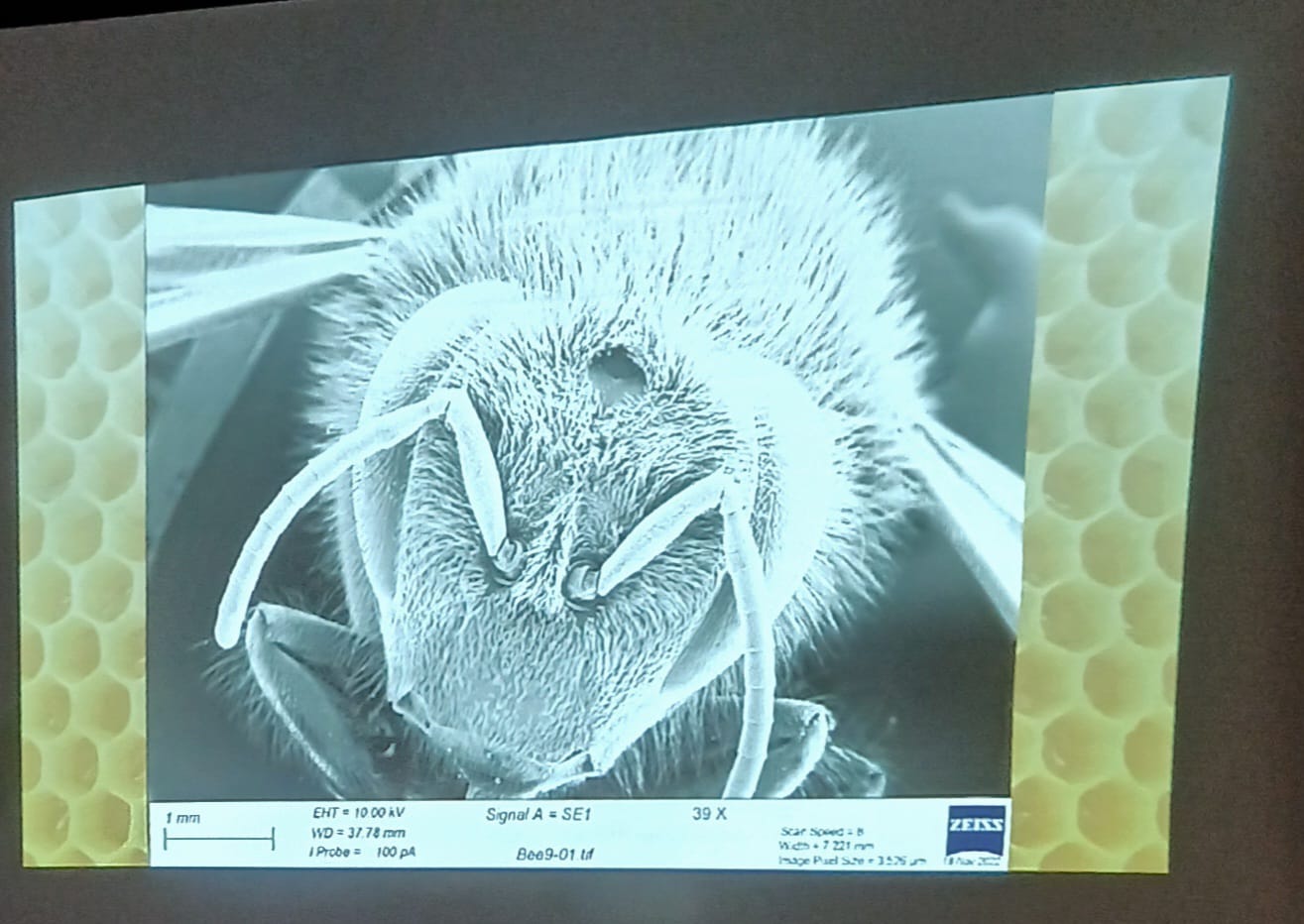
He went on to describe how the bees’ antennae have several functions that are used to detect heat, taste, and movement. Often these antennae get covered in pollen, and the bees use the hooks on their legs to clean them off. They then add a minuscule amount of honey to bind the pollen together and put it into their pollen baskets to form the ball we all recognise.
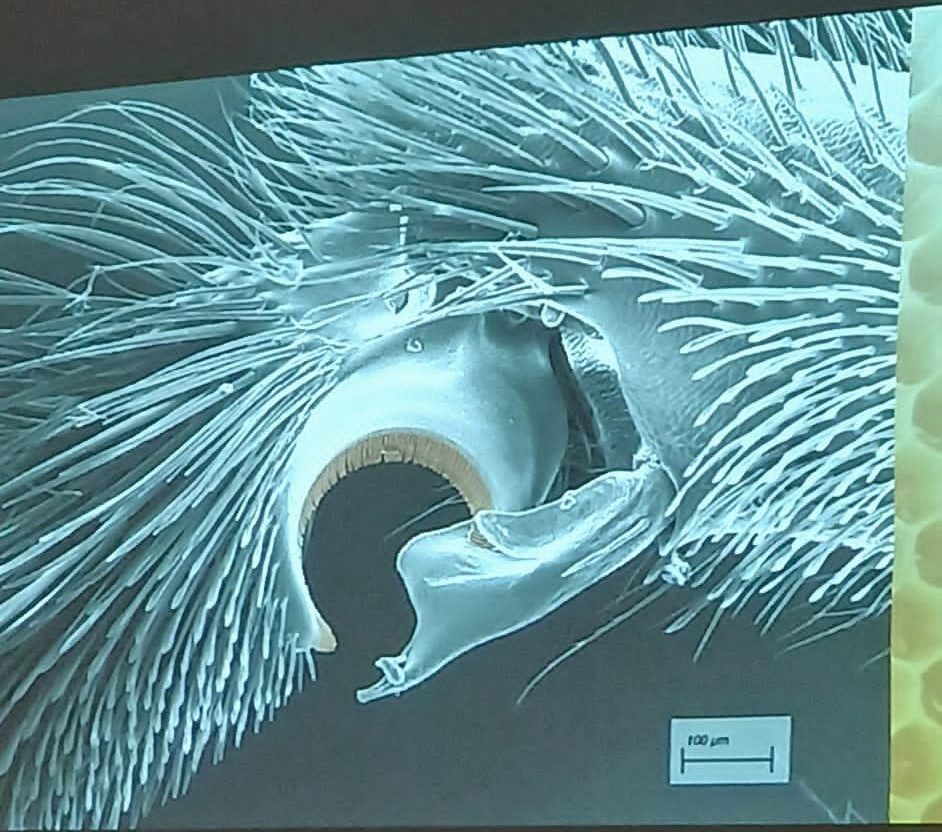
Have you ever wondered how a bee can stick quite firmly to your bee suit or how they can walk up a window? Well, on the ends of their feet they have hooks and teeny-tiny suckers that allow them to do this.
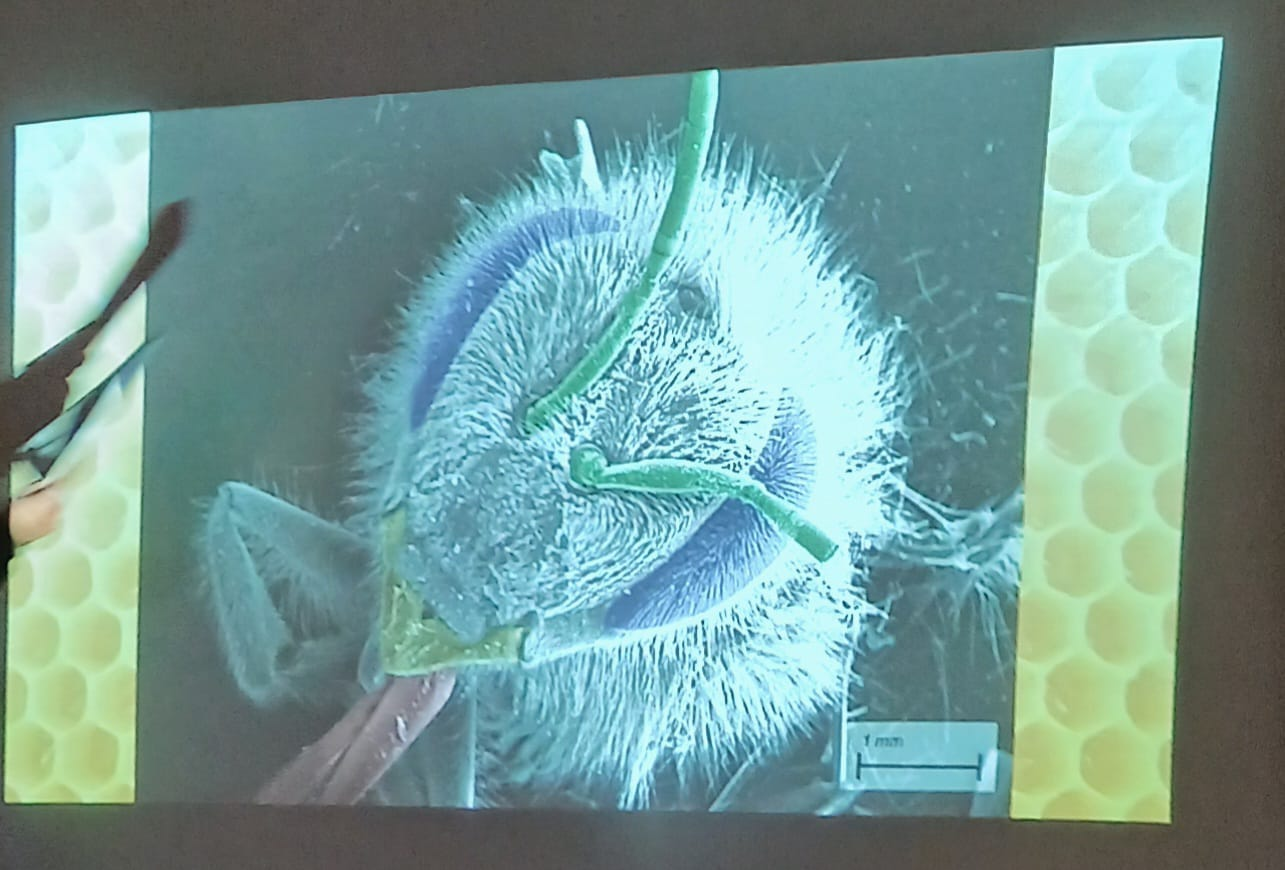
Moving on to bees’ eyes: like we do, bees see things in pixels. A worker bee sees things with a high resolution; whereas a drone only really needs to be able to find the queen and a hive to eat in, and the queen has quite low resolution vision, as she only needs to leave the hive perhaps twice in her life — and she will have her entourage with her to guide her anyway.
By Richard James – Social Secretary


 couple of colonies of bees that hadn’t been opened for about 2-3 years. The beekeeper had sadly become allergic to bee venom.
 spring & move them into standard national boxes. Assuming the queen has survived the move she might be good for breeding as the colony is calm & varroa tolerant (untreated for 3 years).

 I emailed the Abbey and Clare who runs the bee education centre said I could pop and feed the bees with her. She does the Q&A for Beecraft. They don’t have Buckfast bees anymore! She explained why she prefers the ‘mongrels’
 Stone mason, so he moved to shadow the cook who was the beekeeper. His organisation and stubbornness made beekeeping his passion, and ultimately he became a romanticised persona. When he was dying the abbey told him they wouldn’t carry on with his work which devastated him. Clare took over 3 years ago, as she was approached by the abbey as a local beekeeper. She runs workshops for SEND adults and children, ex service therapy sessions, zooms and educational days/weekends. She said it’s a Benedictine mission to educate and be charitable, so she invited me! She stated that her friend who is the optician in the village, travelled with Br Adam to South Africa and he apparently exaggerated and chose evidence to support his opinion which wasn’t accurate (misidentified bees). He also thought the Buckfast bees were immune to the Isle of White disease but made errors with his outcomes. Quirky insights and very interesting but not what I expected.
 It was well organised, we had tables and chairs provided for us. We didn’t have any cover but the weather turned out well with only a few drops of rain. We were in the Nature/Family zone and there was a lot of interest in the observation hive from the public and especially the children. We promoted our Honey Show and also the threat of the Asian Hornet. And gave out information on both. Vesna and Maarten came too and sold a few jars of their honey.

 Sam Walker joined the committee in approximately 2017 where she was the newsletter editor until 2019.She then became president of the branch from 2020-2022.Sam then had a year as our swarm coordinator in 2023 and is now concentrating on her own apiary, teaching bee courses and she is currently our branch Asian Hornet co-ordinator.
 Sharif Khan joined the branch approximately 16 or 17 years ago .He became the president in 2015 and he then moved on to become the treasurer. In 2023 he stepped up and became the acting honey show manager he co ordinated the volunteers ensuring the success of the event.
 Jane Nimmo (seen here collecting her module 5, honey bee biology certificate) has been our education co-ordinator for approximately 4 years. She ran lots of training courses, queen rearing sessions and is always encouraging people to take their basic bee assessment. Jane is currently the secretary for the Wbka.